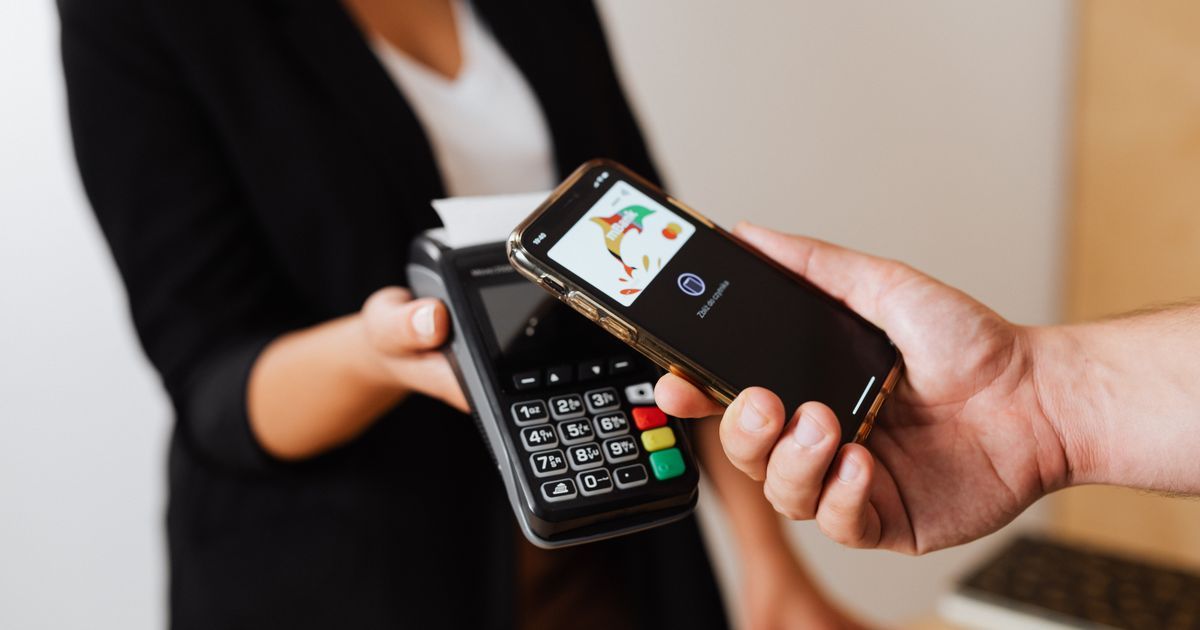
A tap-to-pay transaction looks almost too simple to be real: hold a phone or card near a terminal for a second, hear a beep, and the payment is done. There is no visible wire, no typed password, and often no screen interaction at all. Underneath that simplicity is Near Field Communication, or NFCShort for 'near-field communication,' a very short-range wireless tech that only works within an inch or two. It's what makes tap-to-pay and tapping two phones together to share something work. More in the glossary, a short-range wireless technology built specifically for quick, deliberate, close-range exchanges of small amounts of data.
What makes NFC well suited to payments is not speed or range; it is almost the opposite. NFC only works across a few centimeters, which turns the act of tapping into a clear, physical confirmation that you intended that specific transaction with that specific terminal. Looking at how the technology actually works, from the way it powers a card without a battery to the one-time codes it generates, explains why contactless payment is considered secure despite feeling so effortless.
NFC Is a Very Short-Range Radio Link
NFC is a specialized branch of radio-frequency technology designed to work only within a few centimeters, roughly the distance between your phone and a payment terminal when you hold them near each other. This short range is a deliberate design choice, not a weakness engineers are trying to extend. By limiting the distance so severely, NFC makes it effectively impossible for someone across a room, or even across a counter, to intercept or trigger a transaction without the card or phone being brought right up to the terminal.
This is a direct contrast to Wi-FiA wireless technology that connects devices to the internet through a router, without needing a cable. It reaches farther than Bluetooth but needs that router or hotspot nearby. More in the glossary and BluetoothA short-range wireless technology that connects nearby devices without cables, like a phone to wireless earbuds. It usually works over distances under about 30 feet. More in the glossary, both of which are built to reach as far as practically possible within their design limits. NFC engineers optimized for the opposite goal: the shortest reliable range that still works the instant two devices are brought together, since a longer range would only create more opportunities for unintended or unwanted connections.
How a Card Without a Battery Still Works
A contactless debit or credit card contains no battery and no power switch, yet it can still transmit information. The terminal's NFC reader constantly broadcasts a small amount of radio energy, and the tiny antenna coil embedded in the card picks up that energy and uses it to briefly power the chip inside, a process engineers call energy harvesting. This is why a contactless card works for years without ever needing to be charged: the terminal supplies the power each time, for just the instant the tap takes.
This same energy-harvesting trick is also what allows small NFC tags, like the stickers sometimes used to trigger a phone action, to work without any battery at all. As long as a phone or reader is close enough to supply a brief pulse of energy, the tiny chip inside can wake up, send its small piece of information, and go back to being completely inert until the next time it is brought near a reader.
What Actually Gets Exchanged During a Tap
Contrary to a common assumption, tapping to pay does not transmit your actual card number across the airwaves in a form a nearby device could capture and reuse. Instead, the chip generates a unique, one-time cryptographic code tied to that specific transaction, the terminal, and the moment it happens. That single-use code is what gets sent and verified by the payment network; even if someone somehow captured it, it would be useless for any other purchase, because a new, different code is generated for every single tap.
Why Phones Add Another Layer of Verification
A physical contactless card relies mainly on possession: whoever is holding the card can tap it. Phones typically add identity verification in front of that step, requiring a fingerprint, face scan, or passcode before the NFC chip is allowed to generate and send its payment code at all. This is why a lost phone is often considered safer for payments than a lost contactless card: an unauthorized person holding the phone still cannot get the payment feature to activate without also passing that extra identity check.
NFC Tap-to-Pay Versus Swiping or Inserting a Card
Older payment methods like swiping a magnetic stripe or inserting a chip card into a slot rely on either reading a mostly static stripe of data or a slower back-and-forth conversation between the chip and the terminal through physical contact. NFC tap-to-pay replaces the physical contact with a brief radio exchange and generates that unique one-time code without needing you to insert anything or wait for a slower chip conversation. The result is a transaction that is both faster for the customer and, because of the one-time code, generally considered harder to copy than a magnetic stripe.
NFC Beyond Payments
The same short-range, tap-triggered exchange used for payments also powers other everyday NFC uses, such as tapping two phones together to quickly share a contact or a link, tapping a phone on a smart speakerA speaker with a built-in voice assistant that can play music, answer questions, and control other smart home devices, all through spoken commands instead of buttons or an app. More in the glossary to pair it instantly, or tapping a small NFC tag stuck to an object to trigger an action like opening a specific app. In every case, the deliberate, inches-away tap is doing the same job: confirming that this specific exchange was intentional, between these two specific things, right now.
Many public transit systems also rely on this same principle for fare cards, where a quick tap at a turnstile or reader deducts fare or checks a pass without requiring the card to ever be inserted or swiped. The very short range that makes NFC feel almost too simple for payments is the same property that makes it practical for thousands of commuters to tap through a gate every hour without interference between one person's card and the next person's reader.
Example: What Happens in the Half-Second of a Tap
- Your phone or card enters the terminal's small zone of radio energy as you bring it close.
- That energy powers the chip just long enough to wake it up.
- The chip generates a brand-new, one-time code tied to this exact transaction.
- The terminal receives that code and sends it to the payment network for approval.
- The network confirms it is valid and has never been used before, and approves the payment.
- The whole exchange finishes in well under a second, which is why the beep feels instant.
Common Mistakes
- Believing a tapped card transmits your actual card number, rather than a one-time code generated for that single transaction.
- Assuming a lost contactless card is as risky as a lost phone, when a phone usually requires a fingerprint or passcode before paying.
- Thinking NFC payments can be triggered accidentally from a pocket at a normal walking distance, when the real working range is only a few centimeters.
- Confusing NFC with Bluetooth, since both are short-range wireless, when NFC works at a much shorter range and without any pairing step.
- Assuming every NFC tag or tap does the same kind of payment transaction, when many simply trigger a phone action or share a small piece of information instead.
Frequently Asked Questions
Can someone steal my card information just by walking near me with a reader?
In practice, no; the range needed is only a few centimeters, and the one-time code generated for each tap cannot be reused even if it were somehow intercepted.
Why does my phone sometimes ask for a fingerprint before a contactless payment?
That is an extra identity check layered on top of NFC itself, required by your phone or banking app for larger amounts or after the screen has been off for a while.
Does NFC tap-to-pay work without an internet connection?
The tap itself works locally between the device and the terminal, but the terminal still needs its own connection to reach the payment network and approve the transaction.
Is tapping to pay safer than inserting a chip card?
Both use chip-based security, but tapping generates a fresh one-time code for each transaction and never shares contact with the terminal, which many payment security researchers consider at least as secure as inserting a card.
Why doesn't NFC work when my phone's battery is nearly dead?
Unlike a passive contactless card, a phone's NFC chip and screen still need a small amount of the phone's own battery to operate, so very low battery levels can disable contactless payment even though the phone otherwise looks functional.
Sources
- GSMA — mobile payments and NFC technology standards — https://www.gsma.com/
- NIST — cryptography and secure transaction fundamentals — https://www.nist.gov/