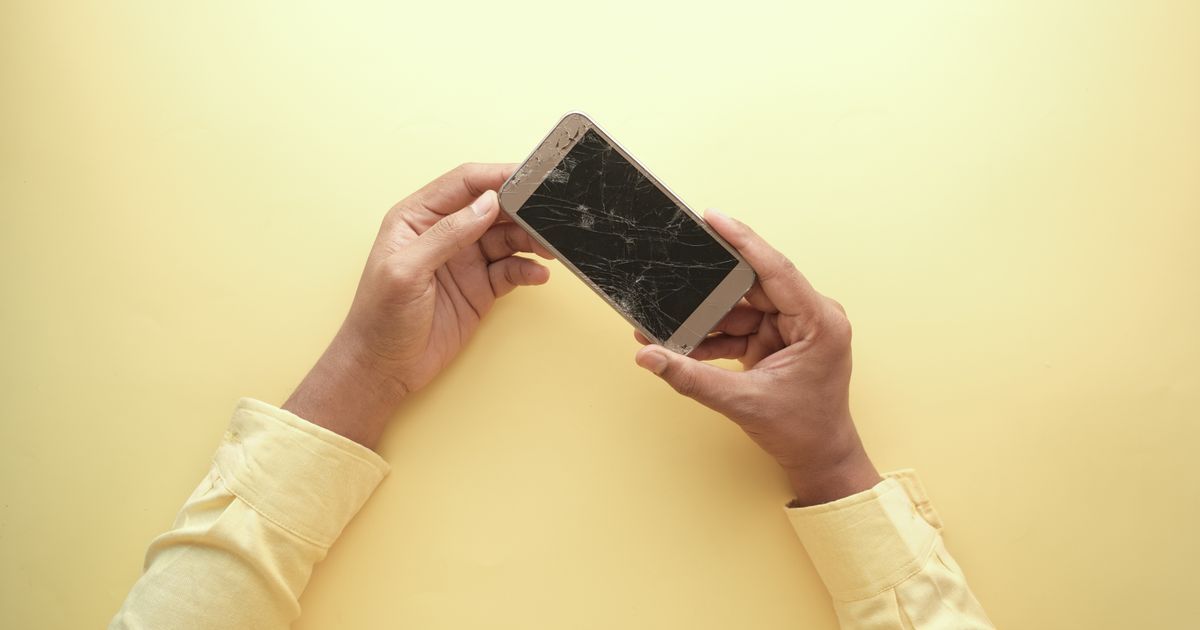
It's a common complaint: modern phones seem to crack more easily than devices from a decade or two ago, despite using more advanced glass and more careful engineering. There's some truth to this, but the explanation isn't that the glass itself got worse. It's that several design trends, thinner bodies, larger screens, edge-to-edge glass, and lighter weight, all shifted in directions that make surviving a drop structurally harder, even as the glass material itself has actually improved.
Cracking is fundamentally a question of how force travels through an object and where it concentrates. A phone screen is a thin, rigid sheet under tension, and the way a device is built determines whether a drop's energy spreads out harmlessly or focuses into a single point sharp enough to shatter glass.
This article looks at the real structural reasons modern screens are more vulnerable, separate from the popular but inaccurate idea that manufacturers are simply using weaker materials.
Thinner Glass Is a Deliberate, Working Trade-off
Screen glass has gotten thinner over the years to keep phones slim and light, and to allow more of the front surface to be active display rather than a thick bezel. Thinner glass is mechanically weaker against point impacts than a thicker sheet of the same material, even if the glass formulation itself is more advanced.
Manufacturers accept this trade-off because extremely thick glass would make phones heavier and bulkier in ways most buyers don't want. The result is a sheet of glass engineered to be strong for its thickness, but still thinner, and therefore more vulnerable to a sharp, concentrated impact, than glass used in older, bulkier devices.
Bigger Screens Mean More Exposed Surface Area
A larger screen covering nearly the entire front of a phone leaves far less non-glass area to absorb or deflect an impact. Older phones with smaller screens surrounded by thick plastic or metal bezels had more of their front surface made of tougher, more impact-resistant material.
With edge-to-edge glass designs, almost any drop lands at least partially on the screen itself rather than on a protective frame, which increases the odds that a fall transfers force directly into the glass rather than into a more forgiving material around it.
Lighter Weight Changes How Force Is Absorbed
A heavier object dropped from the same height carries more momentum, but a lighter one can decelerate faster on impact, which concentrates force into a shorter, sharper spike rather than spreading it over a longer moment. Many modern phones are lighter than older devices, partly due to thinner glass and lighter internal components.
This sharper deceleration can transmit more stress to a small contact point on the glass, especially when a corner or edge strikes a hard surface directly, which is exactly the kind of concentrated force that cracks glass most easily.
Flat, Edge-to-Edge Designs Remove a Protective Buffer
Phones with a raised metal or plastic lip around the glass, common in older designs, meant the frame itself usually hit the ground first in many falls, taking the brunt of the impact before the glass made contact. Many current designs minimize or eliminate that raised lip for a sleeker, more seamless look.
Without that buffer, a flat drop is more likely to let the glass itself make first and full contact with the ground, removing a layer of mechanical protection that earlier phone designs had simply by virtue of their shape.
How a Drop's Energy Concentrates at a Single Point
Glass is strong under even, distributed pressure but comparatively weak against a sharp, localized point of force, like a corner striking concrete or a pebble on the ground. A drop rarely distributes force evenly; it tends to land on one corner or edge, concentrating the full energy of the fall into a tiny contact area.
Once that localized stress exceeds what the glass can handle at that point, a crack starts there and can propagate outward through the sheet, following lines of stress already built into how the glass was cut and tempered.
What Screen Protectors and Cases Actually Change
A case with a raised edge reintroduces some of the protective buffer that flatter phone designs removed, giving the frame a chance to absorb an impact before the glass does. A screen protector, meanwhile, mainly helps against scratches and can sometimes absorb or spread a minor impact, but it generally can't prevent a crack from a hard, direct drop onto a corner, since the underlying glass still receives most of the force.
Together, a case and protector reduce the odds of a crack in many everyday drops, primarily by changing how and where the impact force gets absorbed, rather than by making the glass itself stronger.
Why a Crack Doesn't Always Spread Immediately
Not every crack in phone glass spreads right away into a shattered mess. Tempered glass is manufactured with internal compressive stress near its surface, which can sometimes keep a small, localized crack from expanding immediately, especially if the impact point didn't fully penetrate that outer compressed layer.
Over time, though, repeated handling, additional minor impacts, or temperature changes can cause a contained crack to slowly spread further across the sheet. This is why a phone that survives a drop with only a small corner chip can sometimes develop a longer crack weeks later, even without another obvious impact, as the existing weak point continues to be stressed by normal daily use.
What Changed Between Older and Newer Phone Designs
| Design Factor | Older Phones (Typical) | Modern Phones (Typical) |
|---|---|---|
| Screen size relative to body | Smaller, more bezel | Edge-to-edge, minimal bezel |
| Glass thickness | Thicker | Thinner |
| Raised protective lip | Often present | Often minimal or absent |
| Overall weight | Heavier | Lighter |
| Exposed glass area in a fall | Smaller share of surface | Much larger share of surface |
Common Mistakes
- Assuming newer glass is simply lower quality; most phone glass formulations have actually improved in scratch and impact resistance per unit thickness.
- Believing a screen protector alone prevents cracking from a hard drop, when it mainly helps with scratches and minor impacts.
- Thinking a crack always means the touch sensor is also damaged, when the sensing layer and the glass surface are often somewhat independent.
- Assuming a bigger screen is proportionally more fragile only because of size, without factoring in the loss of a protective bezel or lip.
Frequently Asked Questions
Does a thicker case always prevent cracks?
A case with a raised, rigid edge helps a lot in corner drops, but no case eliminates risk entirely, especially from a hard fall directly on the flat face.
Is tempered glass actually stronger than regular glass?
Yes, tempering creates internal compressive stress that makes the glass more resistant to bending and surface damage, but it's still vulnerable to sharp, concentrated impacts.
Why does a crack sometimes start at a corner even in a flat drop?
Corners often make first contact even in a seemingly flat fall, and they concentrate force into a smaller contact area than the flat face would.
Do larger phones crack more often than smaller ones?
Generally yes, mainly because a larger share of the front surface is exposed glass with less surrounding structural protection.
Sources
- IEEE Spectrum — materials science and consumer device engineering coverage — https://spectrum.ieee.org/
- National Institute of Standards and Technology — materials and fracture mechanics research — https://www.nist.gov/